

Madam Samreen Nurmohamed, Director and Founder tecCGRW of tecGRW Company
Madam Samreen Nurmohamed (SN) has a company named TECGRW involved in using technology in agriculture. She recently participated to ACAT2025 in Kigali. She told to Rwanda News Agency (RNA) that using Technology is the key for increasing productivity in Agriculture. Read the interview:
SN- We have built a couple of greenhouses. One is in Mahama in the refugee camp. One is in Bugesera, one is in Nyaruguru, and one is in Gatsibo. In these greenhouses, we are bringing in technology. And we are controlling the greenhouses sitting in Kigali. Therefore, I can see the greenhouses we built in Gatsibo, Kirehe, Nyaruguru, Bugesera sitting here in Kigali. All the irrigation is automatic and coded, we control the irrigation. The farmer tells us: “We want to irrigate at this time in the morning and this time in the afternoon, it’s automatically done”. Some of them say that we want it based on soil moisture. So if the soil moisture reaches a certain level, we want it to start irrigating.
We control things like humidity, light, temperature, PH, NPK. So if the nutrients are going down, we are there to consult, as well as all the ambient variables. We therefore consult the farmer on all the variables to make their yield a success. And in Mahama, for instance, which is very interesting for us, because some of the other ones are for farmers, but for the one in Mahama, these are refugees who have no agriculture knowledge and they were very resistant. They were like, what is this, in the middle of the camp. But we train them and we empower the communities.
Our technology hubs can now be reset by the farmers or community themselves, who might not be perceived as being very tech-savvy, but trust me, farmers are the most tech-savvy people you will meet. When they are told that something can help them, they will want to learn. Even the dashboards. So the farmer is an amazing person. They embrace the technology even more than the researchers from what I have seen on the ground. And in the months of April and May, in a greenhouse just 16 by 8 meters, 270 kilograms of yellow peppers were harvested (in two months), because we were controlling the production for them. They were selling one kilo at 3,000 RWF.
This for for us is amazing. A testament that the technology works!! And for the other three, they are being run by farmers, small-scale farmers, and they were so impressed that one of the farmers donated their land for this greenhouse to be built and this technology to be embraced. We also train farmers on solutions that can help them and attract young farmers. We train farmers and the youth, because we are also an AI academy. We empower them with the tech, with the knowledge. We show them the power of data.
We believe whether you have education or not, you can still learn and you can still go and use that. We are also working on a solution for small-scale farmers, which will give them access to loan and these loans are going to be interest-free. I can’t talk much about that much at this stage, but it’s coming. And this is homegrown solution in Rwanda, by Rwanda.
We can improve the food baskets with the technology to understand the soil, local weather systems and ambient farm data.
Finally, we also do hydroponics. So we do soilless farming, and again, we are trying to introduce it to small-scale farmers. But for now, we want to bring it in, for a green city.
RNA – Can you estimate how many youth work together in your company?
SN – Our company is led by myself, and we have another six youth who we work with. So my data scientist, software engineer, agronomist, are all local talents. For the communities, each greenhouse, we train at least 150 people in the surroundings you are mainly youth.
RNA – How much have you invested in this project? And can we know the total benefit you have in Rwanda ?
SN – At the minute, we are just breaking even. With good funding, we can scale and further empower small scale farmers.
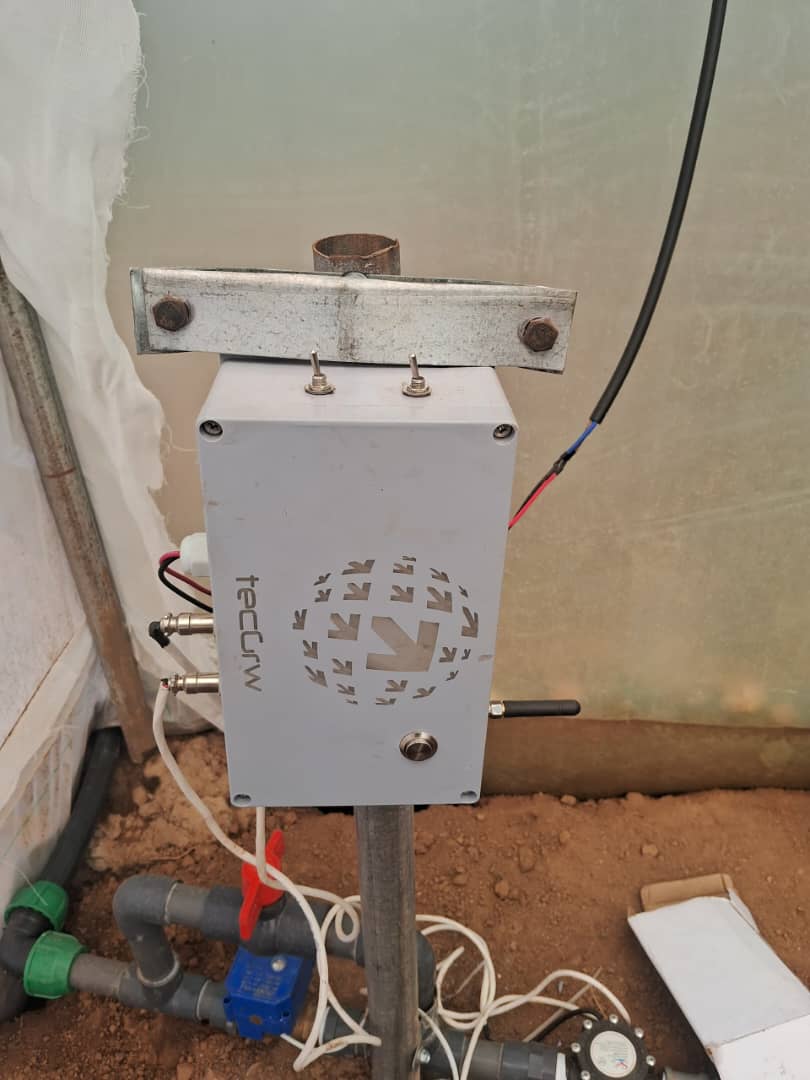
Rwanda is struggling with land. If we can have these smart greenhouses and of course support the farmers on open fields with the IoTs ,solar and automation, we can change the narrative on food security. Our system is all solar-powered, no Wi-Fi needed. It’s all GSM. And I can show you, right now, the dashboard, you’ll see that it uploaded 30 minutes ago, and you can see your data there. We get readings every 15 to 30 mins.
RNA – When will you get a profit? Because an investor must have a profit.
SN – We are hoping that people can see what we are doing, and invest in us, invest in the talent.
And my point, I would say a gap that I have noticed, which is why I was was invited for this interview is that; if you look at most people displaying here, in this ACAT, they are mostly people who are coming from big funding, either Gates Foundation, MasterCard, or other big foundations and organisations, this represents a very small percentage! Where is the platform and the ecosystem for people, locally, with no big funds but with talent ? How do we voice this, so that more people can join us, and we can take this as a movement? Where is that platform to let people like us, who are very small, a small start-up, not funded by any big company, but still doing the job?
RNA – Do you have such a report from some partners?
SN – We have worked with Plan International Rwanda and Imbaraga Farmers Organisation and they can vouch for our work.
RNA – Are you affiliated with AATF?
SN – No we are not affiliated with AATF, they called us for this interview after they heard us talking at one of the sessions for which I am very grateful!
RNA – The cost of the technology, because you can tell us, how much does the greenhouse package, installation in total, the greenhouse, and the technology to ensure that sensors can detect or identify soil moisture, to inform the farmers, how much does it cost?
SN – Absolutely. For a small one now, it’s about RWF 18 million, and that’s because we can’t scale.
If we can scale, we bring that cost down to15-16M. With the technology, with the consultancy and we hand-hold you all the way through. Three million difference if we can build in mass and scale. You can imagine the impact! Three million is a lot of money. We need a voice, so people can know about the technology. We got our projects because of the success of the first one.
We can leverage on economies of scale, cost-cut, make it cheaper and better. We want to recruit more engineers specialising in IoTs. Remember the technology, is not just for Greehouses but small to large scale open field farms too. We can impact how agriculture changes both in a controlled environment space and open in the field.
RNA – So with the Rwf 18 million, you said that’s the smallest structure, facility, greenhouse. Yes. What is the size?
SN – 16M by 8M. And in that size, we harvested 270 kilograms of yellow peppers in two months.
If it is 30M by 8M the yield goes up to almost 550 kgs although the cost to build is not proportionately higher. Oh, good.
RNA – So on the cost-effectiveness, maybe you can tell us, how much does the farmer get? If they invest Rwf 18 million, how much can the farmer get in a given period?
SN – It all depends on what they’re growing. So yellow peppers and red pepper are expensive crops. They can get a higher return, but if you are growing tomato or potato, then your return on investment, is slightly longer. But still farmers agree to give their land because when they are only dependent on open ground, they are not only dealing with the soil-borne diseases, but they also could not control the environment, the sunshine, et cetera, the CO2 and all. Now because we are controlling that, the yield is guaranteed. It’s more guaranteed than if it were in the open field. We are using less space. We can produce up to 1.8 times more in a soil greenhouse than open field. And if you go completely indoors, hydroponic, you can produce up to three times more.
RNA – Yes, but only building resilience of farmers to climate change. You can tell us, how is it helping farmers like be able to produce, even during drought?
SN- Greenhouses is Control Environment Agriculture. Control environment agriculture because the climate has changed, some of the elements of the climate, i.e. sunshine, i.e. more rain than we should have, et cetera, is damaging the crop. But if they come a bit more indoors, i.e. greenhouses, or they go more hydroponic, whereby you’re not dependent on soil-borne diseases, you’re putting the fertilizer in the water, these technologies will help the farmer get high yields. I know there’s a lot of conversation about GMOs and modified crop.
Of course, all that is good. But even that seed, in open field, will not do well as the same seed in a controlled environment right? It will do well at the variable it has been modified on for example, disease, but not overall. In fact, because of the work we are doing , Rwanda is being recognized by the Farmtech Society of in Europe as the only country voicing controlled environment agriculture in East Africa.
RNA: As you have mentioned, you work with different farmers some of whom have limited exposure to technology. Yes. So working with them concerning technology, maybe there are some challenges. If there are, you can mention them, and how you try to overcome them.
SN : The thing with farmers is, everyone comes to them with a story. Lots of promises. They are exhausted. People speak to them like they are unskilled, but unskilled in what? In the tech? But they are the MOST skilled people. They are the subject area experts. They are the brain. We are the tool. Yes? You need to tell the farmer we are here to help you and prove it. Get it right, The first time!!!
That is the key. You don’t get it right the first time, you’ve lost the confidence of the farmer. And you need to show the farmer how it’s going to improve their life. So the farmers know that we are building for them, they are entrepreneurs. They are the ones selling the crop. The profit is theirs. It is their business. We tell them it is your business.
We are here to also help with market access, farm management and post-harvest losses. So when you talk about post-harvest losses, the farmer is more interested. Okay, how are you going to help me? What is the cold chain solution? We at tecGrw, are building that as well.
We are aiming to not only increase the yield for small scale farmers but offer a one-stop solution including finance. We are tecGrw, a Rwandan start up and proudly so! (End)