
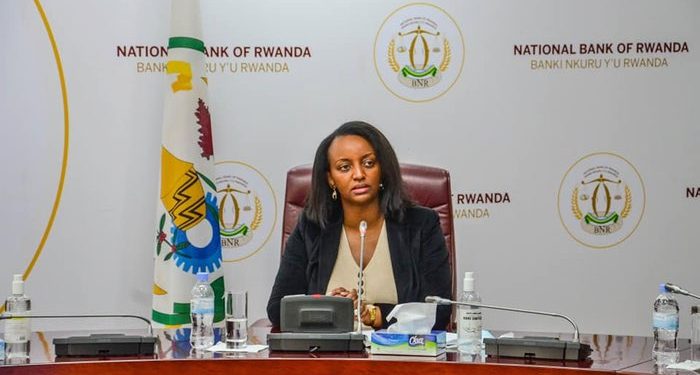
Soraya Hakuziyaremye, Central Bank Governor
On November 18, 2025, the Monetary Policy Committee (MPO) held a meeting to assess recent domestic and international economic trends, to adjust its economic projections and determine the Central Bank Kate (OBR) for the next three months.
In the third quarter of 2025, headline inflation increased to 7.2 percent, up from 6.7 percent in 2025Q2, driven by higher core and energy inflation, despite a decrease in fresh food inflation. Looking ahead, headline inflation is anticipated to average around 6.9 percent in 2025 and 5.8 percent in 2026. Based on these forecasts, the MPC decided to maintain the CBR at 6.75 percent, which is deemed appropriate to keep inflation within the target range.
The domestic economy continued to show strong performance in 2025Q3
Rwanda’s economy experienced a growth of 7.8 percent in the second quarter of 2025, driven by strong performances across all sectors. In the third quarter of 2025, economic activity continued to expand steadily, with the Composite Index of Economic Activities (CIEA) increasing by 13.2 percent, reflecting a rise in aggregate demand. The growth in the CIEA was supported by higher performance in the services and industrial sectors.
Rwanda’s exports continue to grow while the trade deficit slightly widened
In 2025Q3, merchandise exports increased by 15.0 percent, fueled by a rise in coffee and mineral exports, as well as favorable global commodity prices. Non-traditional exports saw a significant surge of 50.5 percent, primarily due to manufactured goods such as cooking oil, wheat flour and animal feeds. Imports rose by 7.4 percent, largely driven by higher consumer goods, particularly medicine and corn. As a result, the trade deficit expanded slightly, increasing by 2.8 percent compared to 2024Q3.
Foreign exchange market pressures eased compared to last year
At end September 2025, the Rwandan Franc (FRW) had depreciated by 4.03 percent against the U.S. dollar year-to-date, an improvement from the 6,49 percent depreciation recorded over the corresponding period in 2024. This moderation was supported by a general weakening of the U.S. dollar against other major currencies and enhanced foreign exchange market regulations to curb speculative tendencies.
Market rates continued to decrease in line with earlier easing of the Central Bank Rate
Following the 25 basis points increase in the CBR in August 2025, money market rates moved closer to the policy rate after a notable decline in 2025Q2. However, the effects of the earlier CBR reductions continued to dominate market conditions on a year-on-year basis. The interbank rate decreased by 140 basis points to 5.85 percent in 2025Q3, from 7.25 percent in 2024Q3. Likewise, the deposit rate fell by 169 basis points to 3.67 percent, attributed to ample liquidity in the banking system. Lending rates also decreased by 28 basis points to 15.78 percent, with this downward trend observed across all loan maturities.
Inflation is expected to average 6.9 percent in 2025 and 5.8 percent in 2026
In 2025Q3, headline inflation rose to 7.2 percent, up from 6.7 percent in the previous quarter. This increase was driven by core inflation which rose to 8.1 percent, up from 5.6 percent, and energy inflation increasing to 3.3 percent, compared to -0,l percent previously. This uptick offset the decline in fresh food inflation, which fell to 5.6 percent from 12.4 percent. The rise in core inflation was largely due to increased costs in health and education, despite a decrease in housing costs. Fresh food prices dropped primarily because of lower vegetable and fruit costs. The increase in energy inflation was mainly attributed to higher solid and liquid fuel prices.
Headline inflation is projected to remain within the target range, averaging 6.9 percent in 2025 and 5.8 percent in 2026. Core inflation is expected to remain high until early 2026 but should gradually decline later in the year. Additionally, energy inflation will stay elevated in the short term, In contrast, food inflation is projected to decrease at the end of 2025 and 2026, supported by robust agricultural output in Season C 2025 and Season A 2026 and casing international food prices.
However, these projections are prone to risks, including possible adverse weather impacting agricultural yields, and geopolitical tensions that could disrupt supply chains, elevate imported commodity prices, thereby exerting upward pressure on inflation.
Given recent developments and the outlook for both domestic and global economies, along with inflation risks, the MPC has decided to maintain the CBR at 6.75 percent, an adequate level to keep headline inflation within the target band. The MPC will continue to monitor economic developments and is ready to take further action to ensure price stability. (End)