
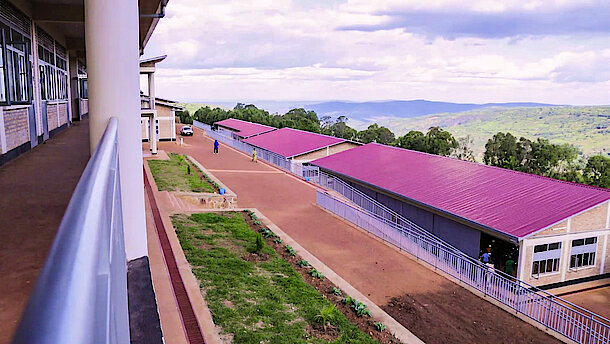
GITI Technical School boosts skills and opportunities for refugees and host communities
Jya Mbere Project, implemented under the Ministry in Charge of Emergency Management (MINEMA) in partnership with the World Bank, continues to make significant strides in improving the socio-economic inclusion of refugees and host communities across five districts hosting refugee camps in Rwanda.
As part of its broader mission to promote self-reliance, resilience and sustainable livelihoods, the project has constructed the GITI Technical Secondary School (TSS) in Gicumbi District, Northern Province. The modern facility aims to equip young people; both from refugee and host communities, with hands-on technical skills that will open up employment opportunities and stimulate local economic growth.
GITI TSS stands as a symbol of progress and empowerment. Designed to accommodate up to 500 students, the school offers training in Automobile Technology and Building Construction; two trades that are in high demand in the country’s development.
With well-equipped workshops, modern classrooms, and qualified instructors, GITI TSS provides a conducive environment for students to gain practical skills that match labour market needs. The school is expected to serve as a model for Technical and Vocational Education and Training (TVET) institutions in the region, nurturing a generation of skilled professionals ready to contribute to Rwanda’s development.
For many students, who joined GITI TSS represent an opportunity to transform their lives and contribute meaningfully to society. “We are determined to excel in our studies and apply what we learn to bring visible change in our communities,” said MUKAMUSONI Clotilde; one of the students from the Automobile Technology department, expressing optimism about the future.
The Head Teacher at GITI TSS Mr. MWIZERWA Aimable commended the Jya Mbere Project for its contribution to improving access to quality technical education. “Our students are expected to deliver tangible results once they complete their studies. They are being trained with high-level skills that will enable them to repair and maintain vehicles, promote modern construction techniques, and create innovative solutions to local challenges,” he explained.
The construction of GITI TSS aligns with the Jya Mbere Project’s principal objective of strengthening the resilience of refugees and host communities by improving access to infrastructure, social services, and livelihood opportunities.
By investing in vocational education, the project seeks to empower youth to become self-reliant, reduce dependency on humanitarian assistance, and contribute to local development.
Technical skills such as automobile mechanics and building construction are essential drivers of Rwanda’s industrialization and urbanization agenda. GITI TSS will not only prepare students for employment but also inspire entrepreneurship and innovation, especially among the youth who aspire to start their own businesses.
Launched in 2019 to address the needs of refugees and host communities, Jya Mbere Project has recently been extended until 2030, allowing more time to consolidate its achievements and expand its impact. This extension demonstrates the Government of Rwanda’s and World Bank shared commitment to long-term, sustainable development interventions to enhance the well-being of refugees and host communities. (End