
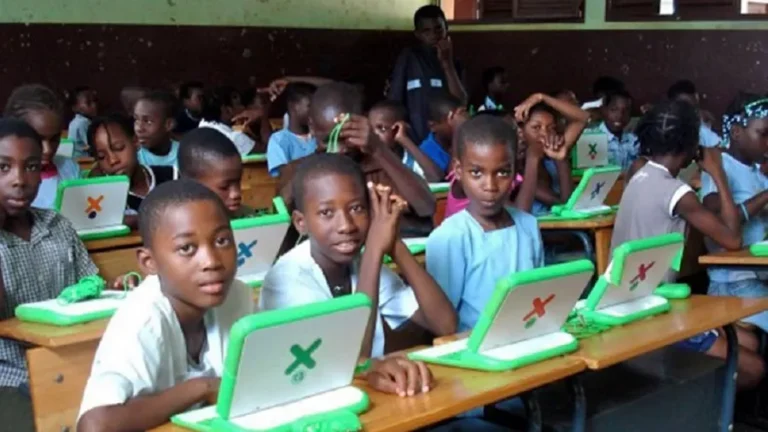
Caption: Rwanda to build 500 smart classrooms nationwide by end of 2017 | Africanews
The new African Union, African Centre for School Leadership and UNESCO Global Education Monitoring report Spotlight Report, Lead for foundational learning, shows that learning levels in Africa are lower than previously thought – only 1 in 10 children in Africa (and 11% in Rwanda) complete primary education and achieve minimum learning proficiency.
Wealth and gender gaps remain areas to address: While 84% of the richest complete primary education in Rwanda, that falls to 36% of the poorest. See the data vizualisation.
The Report highlights school infrastructure in Rwanda as a major issue requiring attention. It cites classroom sizes in Rwanda of over 60 pupils per class, and that one-half of Rwanda’s classrooms are built from temporary materials only. This is partly due to the combined impact of the 1994 genocide and subsequent civil war, which resulted in the destruction and major damage to almost two thirds of all schools.
Manos Antoninis, Director of the GEM Report UNESCO, said “Minimum learning standards start with minimum safety standards. But at present, in half of African countries, temporary materials account for 40% or more of all public primary classrooms. Investing in solid building and classrooms that are not overcrowded helps education to begin, and children’s future to take root. Governments need to make this a priority. They have neglected it in the past 10.years.”
National efforts to build new schools post the genocide and civil war
Progress in building new primary schools was steady but slow during the 2000s and 2010s in Rwanda. An average of only 40 primary schools were constructed annually during the 2000s, increasing only slightly to 50 per year in the 2010s. But at the same time, enrolment levels expanded rapidly, especially after the introduction of the 9-Year Basic Education policy in 2006.
By the late 2010s, classroom congestion, combined with widespread double-shifting, was so serious that the government decided to take decisive action. Between 2019 and 2023/24, in the middle of COVID-19, around 1,100 new schools were constructed, almost all with government and World Bank funding, which was 200 more schools than had been built in total in the previous 20 years. The number of classrooms had grown slowly from 31,000 in 2007 to 46,000 in 2018, but in the period of expansion in the early 2020s, an additional 22,500 new classrooms were built. The student/classroom ratio in government and government-assisted primary schools increased from 60:1 in 2005 to 83:1 in 2020 (ranging from 107:1 in government to 72:1 in government-assisted schools) but fell back to 60:1 by 2024.
Moreover, between 2017 and 2022/23, there were rapid improvements in other areas: on-grid electricity (from 56% to 78%) and access to safe drinking water (from 46% to 69%), tap water (from 53% to 80%) and single-sex toilets (from 71% to 96%). Meanwhile, the student/desk ratio fell from 5:1 to 2:1.
In 2009, the government introduced the Home-Grown School Construction Approach, something that the report recommends to countries such as Nigeria, which are also facing school construction issue. This is an approach heavily based on mass community mobilization driven by traditional values of mutual support and cooperation coupled with effective central and local government backstopping with respect to planning, funding and monitoring.
Almost all classrooms were constructed using this approach in the 2010s. In 2019, with the approach already successfully piloted, all 22,500 new classrooms and 600 new schools were constructed in this way. The World Bank provided a concessional loan of USD 200 million, of which USD 126 million was allocated for the construction of 11,000 furnished classrooms and 14,500 single-sex latrines. The total number of public primary schools almost doubled, from 726 in 2017 to 1,327 in 2022/23 and their share from 25% to 35%, as the number of faith-based schools, in particular managed by the Catholic Church, remained largely unchanged.
A key feature of the programme was off-site construction, whereby classrooms were constructed according to high-quality, modular and standardized designs and prefabricated in dedicated factories, which allowed simultaneous site preparation that shortened overall project timeline by 30% to 50%: all buildings were delivered in six months. The unit cost of classroom construction was around USD 100/m2 compared to USD 2,700/ m2 for conventional, externally funded projects. Small and medium-sized local contractors were used which boosted the local economy. To enhance climate resilience and protect schools, some 600 have been equipped with retaining walls and 1,600 provided with water harvesting tanks. There was strong, dedicated technical and management support with a qualified civil engineer and other supervisory staff posted to all districts. Local education officers and communities had the autonomy to tackle implementation problems.
Future commitments for construction:
The 2024–2029 Education Sector Strategic Plan aims to construct another 18,742 classrooms in public primary schools to achieve the official student/classroom ratio target of 46:1. Another 4,000 classrooms will be built in underserved areas to reduce long travel distances to school. School internet access will also increase from 63% to 85% by 2028/29. (End)